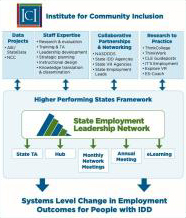
Systems Change

Developing and implementing changes to state employment services is a long-term process that requires changes to policy, practice, funding, performance measurement, and collaboration. An important part of systems change is recognizing that when a state changes one part of their system, they must make complementary changes to other parts of their system. Explore the following resources to learn how state IDD agencies have worked to implement long-term changes.

You can find more examples of systems change on the State Agency Promising Practices page.

Community Rehabilitation Providers resource page has more information about how providers can more effectively help people with IDD find and keep jobs in their community.

State Employment Leadership Network (SELN) Within a University Centers for Excellence in Developmental Disabilities (UCEDD) as a Conduit for Systems Change

publication thumbnail

Freeze, S., Winsor, J., Powers, B., Huppi, A. (2026). UCEDD Innovations Lead to IDD Networks' Driving Change: Envision, Empower, Employ. Developmental Disabilities Network Journal, 5(2) Article 23.

The State Employment Leadership Network (SELN) leverages the ICI/UMass Boston's role as a University Center for Excellence in Developmental Disabilities (UCEDD) to strengthen employment systems change for people with intellectual and developmental disabilities (IDD). ICI’s structure supports collaboration across research, technical assistance, coaching, mentoring, and policy work, helping states build capacity and better support individuals with IDD to achieve their career goals. SELN’s integration within ICI allows staff to identify emerging needs in real time, share resources quickly, and connect related initiatives across projects and partners. Together, these efforts support statewide systems change through technical assistance, networking opportunities, data-informed practices, and research-to-practice initiatives that improve employment outcomes for people with IDD. 

Read UCEDD Innovations Lead to IDD Networks’ Driving Change: Envision, Empower, Employ.


Publications


Kansas Employment First Policy Analysis and Recommendations: Final Report

The Kansas Employment First Policy Analysis and Recommendations report reviews implementation of the 2011 Kansas Employment First Initiative Act, which prioritizes competitive integrated employment (CIE) for people with disabilities. It finds limited progress and identifies gaps in leadership, funding, coordination, training, data systems, and equitable access. Stakeholders prioritized three actions: establish a strong operational leadership group, embed employment across service systems, and implement a sustainable funding strategy to expand high-quality CIE outcomes statewide.

Recommendation Prioritization Working Group for Employment First Implementation: Summary Report

The Kansas Employment First Recommendation Prioritization Working Group met in spring 2025 to advance Employment First implementation. Facilitated by the ICI, stakeholders identified key barriers and prioritized system-change actions using the Higher Performing States Framework. Recommendations include: (1) forming a cross-agency Employment Leadership Team; (2) establishing short-term ad hoc groups on service planning, funding, and capacity building.

Key Findings and Lessons Learned from Research on Integrated Employment for individuals with IDD

This presentation highlights key findings and lessons learned from the RRTC on Advancing Employment for People with IDD (2014-2019). ICI staff discuss a “knowledge to action” agenda that applies empirical data towards the development of strategies to positively impact the employment outcomes of individuals with IDD and their families.

Progressive Policies to Support People with Intellectual Disabilities in Meaningful Competitive Employment

This document outlines comprehensive data gathered from protection and advocacy agencies about efforts around the country to establish progressive policies that improve the opportunities of people with intellectual disabilities to obtain meaningful competitive employment. Download the report here.