Systems Change

Developing and implementing changes to state employment services is a long-term process that requires changes to policy, practice, funding, performance measurement, and collaboration. An important part of systems change is recognizing that when a state changes one part of their system, they must make complementary changes to other parts of their system. Explore the following resources to learn how state IDD agencies have worked to implement long-term changes.

You can find more examples of systems change on the State Agency Promising Practices page.

Community Rehabilitation Providers resource page has more information about how providers can more effectively help people with IDD find and keep jobs in their community.

State Employment Leadership Network (SELN) Within a University Centers for Excellence in Developmental Disabilities (UCEDD) as a Conduit for Systems Change

publication thumbnail

Freeze, S., Winsor, J., Powers, B., Huppi, A. (2026). UCEDD Innovations Lead to IDD Networks' Driving Change: Envision, Empower, Employ. Developmental Disabilities Network Journal, 5(2) Article 23.

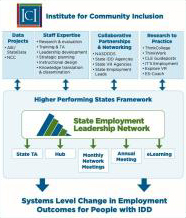
The State Employment Leadership Network (SELN) leverages the ICI/UMass Boston's role as a University Center for Excellence in Developmental Disabilities (UCEDD) to strengthen employment systems change for people with intellectual and developmental disabilities (IDD). ICI’s structure supports collaboration across research, technical assistance, coaching, mentoring, and policy work, helping states build capacity and better support individuals with IDD to achieve their career goals. SELN’s integration within ICI allows staff to identify emerging needs in real time, share resources quickly, and connect related initiatives across projects and partners. Together, these efforts support statewide systems change through technical assistance, networking opportunities, data-informed practices, and research-to-practice initiatives that improve employment outcomes for people with IDD. 

Read UCEDD Innovations Lead to IDD Networks’ Driving Change: Envision, Empower, Employ.


Publications


Emerging Practices, Transition: Funding Mechanisms

In October 2011, the Administration on Developmental Disabilities awarded grants to lead agencies in six states: California, Iowa, Mississippi, Missouri, New York, and Wisconsin. Two additional states, Alaska and Tennessee, received grants in October 2012. These states proposed activities to spur improved employment and post-secondary outcomes for youth with intellectual and developmental disabilities (IDD).

Emerging Practices, Transition: Performance Measurement and Data Management

In October 2011, the Administration on Developmental Disabilities awarded grants to lead agencies in six states: California, Iowa, Mississippi, Missouri, New York, and Wisconsin. Two additional states, Alaska and Tennessee, received grants in October 2012. These states proposed activities to spur improved employment and post-secondary outcomes for youth with intellectual and developmental disabilities (IDD).

Emerging Practices, Transition: Strategic Goals and Operating Policies

In October 2011, the Administration on Developmental Disabilities awarded grants to lead agencies in six states: California, Iowa, Mississippi, Missouri, New York, and Wisconsin. Two additional states, Alaska and Tennessee, received grants in October 2012. These states proposed activities to spur improved employment and post-secondary outcomes for youth with intellectual and developmental disabilities (IDD).

Emerging Practices, Transition: Leadership

In October 2011, the Administration on Developmental Disabilities awarded grants to lead agencies in six states: California, Iowa, Mississippi, Missouri, New York, and Wisconsin. Two additional states, Alaska and Tennessee, received grants in October 2012. These states proposed activities to spur improved employment and post-secondary outcomes for youth with intellectual and developmental disabilities (IDD).

Emerging Practices, Transition: Interagency Collaboration

In October 2011, the Administration on Developmental Disabilities awarded grants to lead agencies in six states: California, Iowa, Mississippi, Missouri, New York, and Wisconsin. Two additional states, Alaska and Tennessee, received grants in October 2012. These states proposed activities to spur improved employment and post-secondary outcomes for youth with intellectual and developmental disabilities (IDD).

44 Series - Financial Well-Being: Reframing the Conversation

  Watch the recorded webinar here. When looking for a new job, it’s logical to “do the math.” We consider what we need (food, housing, healthcare) and what we want (gym membership, car, vacation). We balance potential income against expenses. Finally, we evaluate whether a particular job will help us achieve our goals. Benefits can be a lifeline, but continuous reliance on them can limit people to a life in poverty.

44 Series - Informed Choice and Employment First: What does it Really Mean?

  Watch the recorded webinar here. This webinar looked at the subject of informed choice. What considerations come into play when someone with IDD “chooses work”? What information and exposure or exploration does someone need to decide to leave a familiar setting, such as a sheltered workshop or day program, to work in their community?

Delphi Panel Findings #7: Paths Toward Fair Wages

This is the seventh and final brief in our series on the findings from a Delphi process conducted by the Employment Learning Community in 2013–2014. More information on the Employment Learning Community and the Delphi process can be found in Brief #1 (Introduction, Values, and Overall Themes). This brief focuses on the final priority area for policy and practice change: creating paths toward fairer wages for individuals with IDD. Read the brief here.

Delphi Panel Findings #6: Generation and Use of Data and Evidence

This is the sixth in a series of briefs on the findings from a Delphi process conducted by the Employment Learning Community in 2013–2014. More information on the Employment Learning Community and the Delphi process can be found in Brief #1 (Introduction, Values, and Overall Themes). This brief focuses on how data and evidence can support integrated employment outcomes for individuals with intellectual and developmental disabilities (IDD). This was the fifth overarching theme among the Delphi panel’s recommendations.

Delphi Panel Findings #5: Processes Within State Agencies

This is the fifth in a series of briefs on the findings from a Delphi process conducted by the Employment Learning Community in 2013–2014. More information on the Employment Learning Community and the Delphi process can be found in Brief #1 (Introduction, Values, and Overall Themes). This brief focuses on the fourth priority area identified by the Delphi panel: improving policies and processes within state agencies related to employment for people with intellectual and developmental disabilities (IDD).