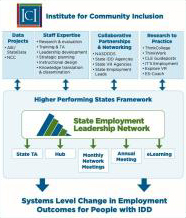
Systems Change

Developing and implementing changes to state employment services is a long-term process that requires changes to policy, practice, funding, performance measurement, and collaboration. An important part of systems change is recognizing that when a state changes one part of their system, they must make complementary changes to other parts of their system. Explore the following resources to learn how state IDD agencies have worked to implement long-term changes.

You can find more examples of systems change on the State Agency Promising Practices page.

Community Rehabilitation Providers resource page has more information about how providers can more effectively help people with IDD find and keep jobs in their community.

State Employment Leadership Network (SELN) Within a University Centers for Excellence in Developmental Disabilities (UCEDD) as a Conduit for Systems Change

publication thumbnail

Freeze, S., Winsor, J., Powers, B., Huppi, A. (2026). UCEDD Innovations Lead to IDD Networks' Driving Change: Envision, Empower, Employ. Developmental Disabilities Network Journal, 5(2) Article 23.

The State Employment Leadership Network (SELN) leverages the ICI/UMass Boston's role as a University Center for Excellence in Developmental Disabilities (UCEDD) to strengthen employment systems change for people with intellectual and developmental disabilities (IDD). ICI’s structure supports collaboration across research, technical assistance, coaching, mentoring, and policy work, helping states build capacity and better support individuals with IDD to achieve their career goals. SELN’s integration within ICI allows staff to identify emerging needs in real time, share resources quickly, and connect related initiatives across projects and partners. Together, these efforts support statewide systems change through technical assistance, networking opportunities, data-informed practices, and research-to-practice initiatives that improve employment outcomes for people with IDD. 

Read UCEDD Innovations Lead to IDD Networks’ Driving Change: Envision, Empower, Employ.


Publications


How is guardianship status related to employment status for people with IDD? Findings from the National Core Indicators Adult Consumer Survey.

Read the brief here. This study examined data from a sample of 12,213 people with IDD who responded to the NCI Adult Consumer Survey in 2012–2013. The sample captures data from respondents in 26 states. The purpose of the study was to observe and describe different demographic characteristics among the respondents, and how those characteristics correlated to different outcomes. The findings of this study showed a correlation between legal guardianship and employment setting for individuals with IDD.

Partnerships in Employment: Guidance on How to Obtain Data on the Use of Subminimum Wages

PIE project work is framed by the High-Performing States Transition Model, which contains 8 key elements: collaboration, leadership, state goals and policy, funding and contracting, staff training, service innovation, performance management and quality assurance, and youth leadership development and family engagement. This document is one in a series of PIE Project Fact Sheets that chronicle how PIE grantee states are making change under the elements of the High-Performing States Transition Model.

Partnerships in Employment: Summary of Section 1915(c) Home and Community Based Services Waivers and Section 1915(i) State Plan Home and Community Based Services

This is a resource document prepared for a Community of Practice (COP) on using Medicaid funds as a resource to support individual integrated employment. The COP is hosted by the Partnerships in Employment Training and Technical Assistance Center for Partnerships in Employment grantees. The goal of the COP will be to provide opportunities to learn about the ways in which 1915(c) Home and Community Based Waivers and 1915(i) State Plan Home and Community Based Services have been used to support integrated employment in federal statue and in states with PIE grants.

Partnerships in Employment: State Self-Assessment Toolkit for Systems Change in the Transition of Youth and Young Adults with IDD from High School

This self-assessment tool was developed for those who wish to embark on state-wide governmental systems change to improve high school transition and employment outcomes for youth and young adults with intellectual and developmental disabilities (IDD). Its purpose is to aid in the development of a work plan that is based on a review of the state policies, practices, and strategies that impact transition from school and opportunities for competitive integrated employment of youth and young adults with IDD.

Partnerships in Employment: Building a Transition-to-Employment Agenda

The national Partnerships in Employment (PIE) readiness preparation that impacts post- National Transition Systems Change Project was established in 2011 by the Administration on Intellectual and Developmental Disabilities. This five-year project focuses on improving, developing, and implementing policies and practices that raise community expectations and overall employment outcomes for youth with intellectual/developmental disabilities (I/DD).

Partnerships in Employment: Engaging Families of Youth with Intellectual Disabilities in Systems Change Efforts

Youth with intellectual disabilities often face challenges when preparing to leave school settings to move into life in their communities. These young adults may experience high rates of unemployment, increased rates of poverty, and involvement in service systems that do not have the resources needed to provide quality services for all who need them.

Emerging Practices, Transition: Youth Leadership and Family Engagement

In October 2011, the Administration on Developmental Disabilities awarded grants to lead agencies in six states: California, Iowa, Mississippi, Missouri, New York, and Wisconsin. Two additional states, Alaska and Tennessee, received grants in October 2012. These states proposed activities to spur improved employment and post-secondary outcomes for youth with intellectual and developmental disabilities (IDD).

Emerging Practices, Transition: Training and Technical Assistance

In October 2011, the Administration on Developmental Disabilities awarded grants to lead agencies in six states: California, Iowa, Mississippi, Missouri, New York, and Wisconsin. Two additional states, Alaska and Tennessee, received grants in October 2012. These states proposed activities to spur improved employment and post-secondary outcomes for youth with intellectual and developmental disabilities (IDD).

Emerging Practices, Transition: Services and Service Innovations

In October 2011, the Administration on Developmental Disabilities awarded grants to lead agencies in six states: California, Iowa, Mississippi, Missouri, New York, and Wisconsin. Two additional states, Alaska and Tennessee, received grants in October 2012. These states proposed activities to spur improved employment and post-secondary outcomes for youth with intellectual and developmental disabilities (IDD).